By Paul Murphy and Randy Weisz
Small grain variety performance can vary greatly from one year to the next. This makes it nearly impossible to pick a single “best” variety. Consequently, producers should plant two or more varieties every season. Growing at least two varieties will reduce the risk of freeze injury, pest damage, and other forms of crop failure and maximize the potential for a high-yielding crop.
Small grain varieties generally have the highest yields and milling quality during the first couple years after their release. Consequently, the varieties grown on a farm should change over time. This makes it important to keep up with newly released varieties and determine how they will do locally. Plant newer varieties on a small section of land. Then plant the most consistent performers on the majority of land, phasing out the older varieties that show signs of succumbing to disease and insect pressures.
The best source of unbiased public and private variety performance information for North Carolina is the Official Variety Test Report (OVT) produced annually by Daryl Bowman of the Crop Science Department, Box 8604, NC State University, Raleigh, NC 27695. It is updated every July, and is at http://www.ovt.ncsu.edu/.
Producers in counties adjacent to Virginia or South Carolina also may find the offcial variety test reports from these states to be valuable. The Virginia report can be found at http://www.ext.vt.edu/cgi-bin/WebObjects/Docs.woa/wa/getcat?cat=ir-cg-gr.
Small grain varieties that have been in Official Variety Tests for more than one year are usually all good candidates for production. Avoid investing in varieties that have not been entered into these tests, since they usually are not adapted to North Carolina conditions. The test reports give information on each of the following variety characteristics.
Grain Yield
The most reliable data upon which to base variety choices are the 2- or 3-year average yields at the test location closest to the particular farming operation.
Test Weight
High-test weight is usually associated with good quality. A low test weight will result in dockage at the elevator. Some varieties consistently have superior test weight. However, even a high-test-weight variety will produce a low-test-weight grain if drought, potassium or sulfur deficiencies, fungal diseases, lodging, or wet weather at harvest occur. Coastal plain producers with deep sandy soils who need high-test-weight grain should be alert for potassium and sulfur deficiencies.
Heading Date
“Heading date” is an important indication of how susceptible a variety will be to late spring freeze damage. Early heading varieties are the most susceptible to freeze damage. Conversely, planting late heading varieties reduces the risk of yield losses due to spring freezes.
Barley is the earliest of the small grain species to head, so it is at greatest risk of suffering spring freeze damage and yield losses. In North Carolina, the variety Boone has been a long-time standard for barley producers and has rarely suffered late spring freeze damage. Barley varieties that head earlier than Boone have a greater risk of yield reduction from freeze damage.
For wheat, medium and late heading varieties are more likely to avoid spring freeze damage, and generally produce higher yields than early or medium-early heading varieties. Heading date also indicates when a wheat variety should ideally be planted. Medium and late-heading wheat varieties tend to do best when planted at the start of the planting season, and consequently should be the first varieties a producer plants. Early and medium-early varieties tend to produce the highest yields when planted later in the fall. Wheat variety heading date can also be found at http://www.smallgrains.ncsu.edu/Varieties/Varieties.html.
Disease Resistance
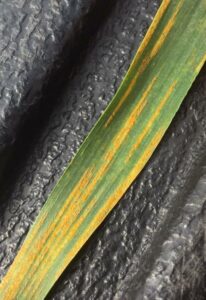
Powdery mildew and leaf rust pressure varies greatly across the state. Small grains in the central and western regions of North Carolina are at low-risk to these diseases, while pressure is generally high east and south of Raleigh, forming a high-risk zone in the coastal plain and tidewater (Figure 3-1). For producers in the high-risk and transition zone between the two areas, disease resistance is extremely important in making variety selections. (To see color pictures of powdery mildew, go to http://oak/ppws.vt.edu/stromberg/smallgrain/biology/wpmildew.html. For color pictures of leaf rust, go to
http://oak.ppws.vt.edu/stromberg/smallgrain/biology/wlrust.html.)
Powdery mildew is a fungal disease that is a serious problem in wheat, but it rarely occurs above economic threshold levels in barley or oats. Do not plant wheat varieties with poor mildew resistance in high-risk areas unless 1) a fungicidal seed treatment (e.g. Baytan) is used, or 2) the field is scouted and a fungicidal spray application is made if the threshold is met, or 3) the variety is planted late to avoid fall mildew infestation. Leaf rust, like powdery mildew in wheat is a greater problem in the high-risk zone. Do not plant wheat varieties with poor rust resistance in the high-risk zone unless the management strategy includes spring scouting and fungicide spray application if the disease threshold is met. Rust in oats also occurs in the high-risk zone, but in most years it does not reach economic threshold levels. No barley varieties currently on the market are rust resistant. Wheat varieties with powdery mildew and leaf rust resistance can also be found at http://www.smallgrains.ncsu.edu/Varieties/Varieties.html.
Hessian Fly Biotype-L Resistance
In recent years, numerous wheat fields throughout North Carolina have suffered extensive losses because of Hessian fly infestations. Other small grains, such as oats, barley, and triticale, are not attacked by this insect. Wheat varieties resistant to Hessian fly have been developed. However, to be effective, the resistance must be for the specific type of Hessian fly (biotype-L) present here in North Carolina. A list of wheat varieties resistant to Hessian fly biotype-L can also be found on the Internet at: http://www.smallgrains.ncsu.edu/Varieties/Varieties.html.
Lodging
Lodging is generally a greater problem in barley and oats than in wheat. Under intensive management practices, however, lodging will occur at a greater frequency in all small grains. A lodged crop can reduce test weight and slow combine operation. Variety information related to lodging can be found at http://www.smallgrains.ncsu.edu/Varieties/Varieties.html.

Milling and Baking Quality of Wheat
Millers and bakers in North Carolina use wheat for a diverse range of products, and certain varieties are superior to others for production of specific products. Therefore, producer growing wheat for sale directly to a mill, should discuss variety choice with the mill quality-control staff. Just like test weight, even a high baking-quality variety can produce a low quality grain if nitrogen, potassium, or sulfur deficiencies, fungal diseases, lodging, or wet weather at harvest occur.
In addition to finding top yielding varieties in the most recent Official Variety Test Report, no-till producers should keep several other facts in mind when choosing varieties. Tillering and fall growth are often slower in no-till small grain production. Consequently, no-till producers who are not planting into organic soils often achieve higher yields if they plant during, or slightly ahead of the opening planting dates (see the back cover of this guide or go to http//www.smallgrains.ncsu.edu/Guide/backcover.html.)
Planting early requires special care to select varieties that 1) are medium or late heading to avoid freeze damage, 2) that have good Hessian fly resistance to prevent fall infestations, and 3) if planting in the high risk powdery-mildew zone that have good powdery mildew resistance. No-till small grains planted into corn or wheat residue are also at increased risk to Fusarium head scab. (To see color pictures of Fusarium head scab, go to http://www.smallgrains.ncsu.edu/Diseases/ScabPictures.html.). Head scab produces mycotoxins that can result in the harvested grain being unacceptable for animal or human consumption. (For more information about managing mycotoxins in livestock feed, go to http:// www.ces.ncsu.edu/disaster/drought/drought/dro-29.html.) Some wheat varieties currently available have some resistance to head scab, and no-till producers should consider using several of these varieties in their production system. The most current information about variety resistance to head scab can be found in the Virginia official variety test report, which is at http://www.ext.vt.edu/cgi-bin/WebObjects/Docs.woa/wa/getcat?cat=ir-cg-gr.
Growers should contact the Cooperative Extension Center in their county or go online to get a copy of the North Carolina Official Variety Test Report every July. Use the 2- and 3-year average yield information to choose the best yielding varieties for a first cut. From these varieties, choose a medium- to late-heading variety for timely planting, and early and medium-early heading lines for later plantings. Producers in the high-risk powdery mildew and leaf rust zone should eliminate varieties that have poor powdery mildew or rust resistance (or consider fungicidal seed treatments, fungicidal foliar sprays, or late planting). Producers who have suffered from Hessian fly infestations should also consider varieties with resistance to this pest.
Return to Index: http//www.smallgrains.ncsu.edu/Guide/cover.html
This file is a chapter from Small Grains Production Guide, 2004-05. Recommendations for the use of agricultural chemicals are included in this publication as a convenience to the reader. The use of brand names and any mention or listing of commercial products or services in this publication does not imply endorsement by the NC Cooperative Extension Service nor discrimination against similar products or services not mentioned. Individuals who use agricultural chemicals are responsible for ensuring that the intended use complies with current regulations and conforms to the product label. Be sure to obtain current information about usage regulations and examine a current product label before applying any chemical. For assistance, contact your county Cooperative Extension Center.
Published by
North Carolina Cooperative Extension Service
Distributed in furtherance of the Acts of Congress of May 8 and June 30, 1914. North Carolina State University and North Carolina A&T State University commit themselves to positive action to secure equal opportunity regardless of race, color, creed, national origin, religion, sex, age, or disability. In addition, the two Universities welcome all persons without regard to sexual orientation. North Carolina State University, North Carolina A&T State University, U.S. Department of Agriculture, and local governments cooperating.
9/04—3M—JMG (AG-580 (revised) EO4-43980
Last Revised Sept. 2004