By Ron Heiniger and Randy Weisz
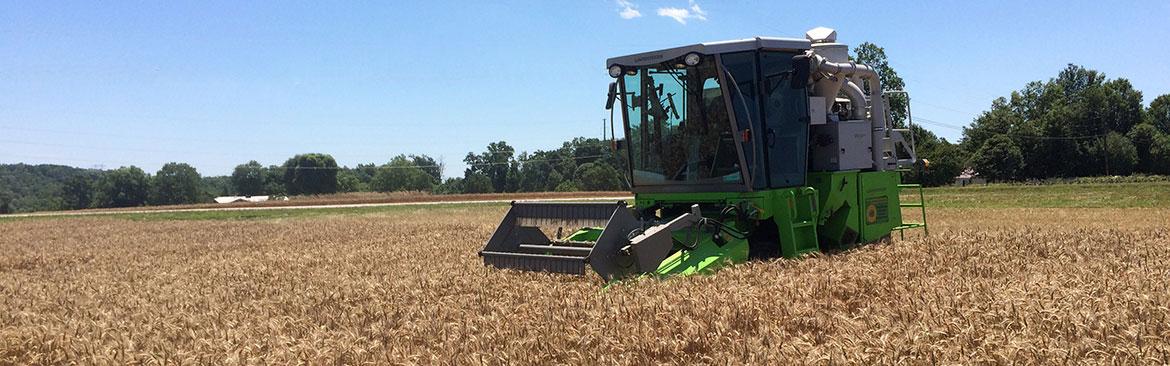
Increasing interest in soil conservation and the need to improve soil structure and increase organic matter have more growers considering no-till cropping systems. The key benefit of no-till small grain production is the ability to plant in a more timely way with less investment in time and machinery costs. Since there is a short window of opportunity between corn and soybean harvest and planting wheat, no-till wheat producers can plant more acreage at reduced cost than those who have to gear up for conventional land preparation. The other important benefit of no-till small grain production is that it allows growers to establish a full no-till cropping system. The best chance of increasing soil organic matter and improving soil structure over the long term occurs when all crops in the rotation are planted using no-till practices. However, no-till small grain production is not for the casual producer. No-till systems often result in changes in the distribution and availability of critical nutrients, delayed plant growth and development, and an increase in the severity of disease and insect infestation. To be successful, no-till small grain production requires special management considerations and attention to small details to overcome these problems.
No-till systems change in the movement of water, lime, and nutrients in the soil profile. As the soil structure improves under no-till, water movement through the upper soil profile generally increases on well-drained silt loam or clay loam soils. However, on poorly drained soils or soils where compaction is a problem, water movement through the profile often results in waterlogged soils and poor plant growth. Because there is no tillage, lime and nutrients are not incorporated or mixed throughout the upper soil profile. When water movement through the soil is reduced, lime and nutrients in the soil and higher levels of nonsoluble nutrients, such as phosphorus, remain in the upper 4 inches of the soil profile.
Well-drained, silt loam and clay soils are best suited to no-till production. Sandy soils have been less successful, and poorly drained soils are not suited for no-till small grains. Growers with sandy, coastal plain soils with more than 12 inches to clay often find that no-till cropping systems, where no tillage occurs in any of the rotation crops, increases soil compaction. In such cases, some deep tillage during one of the crop rotations may be required. On poorly drained soils, land leveling and/or the installation of tile drainage is necessary. Examine soil classification and drainage class for each field to determine how to manage soils for no-till production. Also, before starting no-till small grain production, till the field to make it as uniform and free of gullies and wheel ruts as possible.
When starting a no-till cropping system, the soil should be tested to determine pH, phosphorus, or potassium levels. If lime is required, apply the lime, and till it in before the first no-till crop. Apply phosphorus and potassium with the goal of increasing field index values to at least 50 for phosphorus and 75 for potassium. Once a no-till system has been established on a well-drained soil where compaction is not a problem, add lime, phosphorus and potassium as indicated by soil test and leave it unincorporated on the soil surface.
There is no substitute for a soil test to determine optimum phosphorus, potassium, and lime
requirements. In the absence of tillage, nonsoluble nutrients like phosphorus become concentrated in the upper few inches of soil. Soil tests from long-term, no-till fields in North Carolina show that soil from the upper 4 inches generally had about 22 index points more phosphorus than soil samples pulled from the upper 8 inches. Small grains appear to compensate for this by growing more roots in the upper few inches. How this may affect yield is uncertain. It does, however, have an impact on how no-till fields should be sampled. Take soil samples for no-till soil tests from the upper 4 inches only!
MANAGING FOR THE DELAY IN PLANT GROWTH AND DEVELOPMENT
No-till often reduces early plant development in the fall and winter. This reduction in early growth can result from a number of factors, such as increased compaction in the upper few inches of soil and increased severity of seeding diseases like Rhizoctonia. Another common cause of poor no-till stands and slow growth is planting into soils that are too wet. No-till gets equipment onto wet soils earlier than is possible on tilled land, but just because the soil is workable does not mean it is dry enough to plant small grains. However, the most common cause of reduced early growth is lower soil temperature. Crop residues left on the soil surface act as insulation resulting in cooler soil temperatures that slow germination, reduce the rate of seedling growth, and slow tiller development. Since tillers produced in the fall are the most likely to produce more kernels per spike and contribute to a high yield, this puts no-till at a disadvantage compared to systems using tillage.
Plant no-till wheat on time or a little early. This gives the slow growing, no-till wheat more time to tiller before cold winter weather arrives. Yield studies in the North Carolina coastal plain have shown that getting no-till wheat drilled right at the start of the planting season results in the best yields. Waiting as few as 3 weeks after the start of the planting season, which is when many producers are just starting to plant, may lower yields. Reduced yields associated with late no-till planting can also be caused by late fall rains that cause no-till soils to stay wet and waterlogged under the crop residue. Wheat stands simply do not do well in these conditions and often deteriorate. Planting no-till wheat early increases yield potential.
Unfortunately, planting no-till early in the season also has several serious problems. Early planting increases the risk of Hessian fly infestation, aphid infestation resulting in barley yellow dwarf, increased potential for powdery mildew, and spring freeze damage. Reduce Hessian fly infestations by planting varieties resistant to the Biotype L Hessian fly (see variety information at: http://www.smallgrains.ncsu.edu/Varieties/Varieties.html) and by careful scouting to determine if an insecticide should be applied in the fall (see recommendations in the Insect Pest Management section of this guide). Where barley yellow dwarf is common, plant resistant varieties and/or use an insecticidal seed treatment. Because powdery mildew is a common problem in most years and in all areas of the state, growers should select small grain varieties with resistance to powdery mildew (see variety information at http://www.smallgrains.ncsu.edu/Varieties/Varieties.html).
Avoiding a spring freeze is more difficult. To avoid spring freeze damage, use late heading varieties, especially those with “daylength sensitivity.” Late maturing or daylength sensitive varieties flower later in the spring, which reduces the risk of freeze damage during this critical period. Wheat variety heading dates can be found at http://www.smallgrains.ncsu.edu/Varieties/Varieties.html.
Organic soils in Eastern North Carolina typically cool very quickly at night and are at extremely high risk to spring freeze in no-till wheat. This makes no-till production on these soils difficult. No-till growers with organic soils should pay close attention to variety maturity and daylength sensitivity and never plant an early maturing wheat variety.
No-till producers have to be much more careful in selecting seeding rates than conventional growers. Since soils vary greatly in surface bulk density and compaction, no-till growers need to experiment with their drill, their residue situation, and their soil conditions in selecting a seeding rate that will produce a uniform stand with at least 24 plants per square foot present after emergence (more if planting late). A new no-till producer might want to start by increasing the standard recommendation for seeding rate by 20 percent and then scout the wheat soon after it emerges to determine if the target population of 24 plants per square foot has been achieved. Subsequent plantings can then be adjusted based on the results obtained. It can be hard to recover from a thin no-till stand! Plant at a higher seeding rate and then adjust downward as experience and confidence with soil conditions and equipment increases.
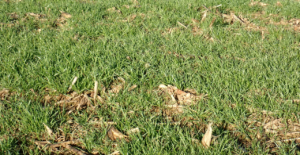
Good soil-seed contact is critical for small grain stand development, and drilling through crop residues on the soil surface can make uniform seed placement at the proper depth much more difficult. Consequently, successful no-till production begins at harvest of the previous crop. Distribute crop residues uniformly across the soil. Uneven crop residue is one of the major causes of poor stands. A chaff spreader can improve residue distribution and the ability to drill the small grain seed. Opinions differ about the impact shredding corn residue has on drilling small grains. When diseases like scab were not a problem, onfarm research found no consistent difference in yield between shredding or not shredding corn residue. Some growers get better drill performance if corn is harvested and shredded well in advance of drilling small grains. This appears to be the result of getting the corn residues down into the soil surface where moisture can increase decomposition. When corn is harvested close to the planting of small grains, the effectiveness of shredding differs from farm to farm. Some producers get better drill performance by leaving the “green” stalks standing and drilling into the standing stubble. Other drills seem to perform better when the stalks are mowed. When starting no-till, leaving strips of shredded and unshredded corn stalks and comparing drill performance in both will help the grower determine which approach is best with specific equipment. When no-till small grains follow cotton, many producers find that they get better drill performance by leaving the cotton stalks standing, and then shredding or bushhogging after the small grain is planted.
The risk of winterkill and damage from drought in no-till is often higher than in conventional fields. Onfarm observations suggest one reason for this might be shallow seed placement when planting through heavy residue. Shallow seeds are exposed to lower soil temperatures, which leads to winterkill. If crop residues are unevenly distributed, seed placement can vary greatly as the depth gauge on the openers rides up over the areas of heavy residue and seed depth is reduced. Since residue density can vary with soil properties or moisture conditions during the previous cropping season, it is very important to check seed placement frequently even when planting in the same field. Growers using no-till drills should make it a habit to stop at different locations within a field and check to ensure seeds are being uniformly planted at a depth of 1 to 1.5 inches below the soil surface.
At-Plant Nitrogen
Research in North Carolina has found that 30 pounds nitrogen applied at planting time is generally enough for no-till production. Many no-till producers commonly use higher nitrogen rates at planting, especially when planting late, but this has not resulted in better yields. Surprisingly, nitrogen applied at planting does the most good when wheat is planted during the opening planting dates! Because cooler temperatures limit wheat growth, wheat planted in the later part of the season will not respond to nitrogen applied at planting. Therefore, growers planting during the opening planting dates should apply nitrogen as part of their starter fertilizer. When planting later in the season, increasing nitrogen rates in no-till does not help and only adds cost to an already thin budget sheet!
Topdress Nitrogen
Research in North Carolina has consistently shown that producers using no-till must pay particular attention to nitrogen fertility in the early spring. This is because no-till stands often produce fewer tillers than conventional fields by the first signs of spring. There is only a short time in the early spring, just before jointing, to increase the number of tillers in no-till fields, and this can only happen if the plant has enough nitrogen. Usually, there is very little plant available nitrogen left after a wet winter. Check tiller number in wheat as soon as the weather starts to warm up (or even just before) in late January or early February. No-till stands with more than 50 threeleafed tillers per square foot do not require early nitrogen and should get all their spring nitrogen just before jointing. Stands with fewer than 50 tillers per square foot need an early application of nitrogen as soon as possible to stimulate tiller development.
See the nitrogen fertility ( http://www.smallgrains.ncsu.edu/Guide/Chapter8.html) section of this guide to determine how much nitrogen to apply to increase tiller number.
Crop Residues and Nitrogen
No-till small grain producers often wonder what affect the surface residue has on plant available nitrogen. All crop residues contain some nitrogen depending on the type of crop, soil fertility and the weather during the previous cropping season. The question is whether the nitrogen present will become available for the new crop. Research in North Carolina has shown that as crop residues degrade during the wheat season, plant available nitrogen decreases. Microbes use both crop and soil nitrogen as an energy source. Since there is more exposed crop residue, there is more demand by microbes for nitrogen and this demand remains constant until late in the spring. Therefore, none of the nitrogen tied up in crop residue becomes available during the fall or early spring for a small grain crop. In fact, sometimes it is not released until subsequent crops. Do not decrease the amount of nitrogen applied based on the expectation that nitrogen from the crop residue will contribute to the requirements for no-till wheat.
No-till small grain systems require a weed-free seedbed for best results. A weed-free environment results in warmer soils and less early competition for light and nutrients. When planting wheat, apply a burndown herbicide (see the section on small grain herbicides for recommended herbicides at http://www.smallgrains.ncsu.edu/Guide/Chapter14.html) at least 7 to 10 days prior to planting. This is especially important when planting into fields where grassy weeds are a problem. Since aphids prefer grassy species and closed canopies, apply the burndown herbicide early enough to eliminate all green vegetation by the time the weeds emerge. Otherwise, aphids will simply move from the dying weeds to the emerging wheat plant, increasing damage from either the aphid or disease and slow growth.
Be aware that weeds like annual ryegrass will be more of a problem because they compete better when wheat growth and development is slow. Growers should know based on past observations of the field the potential for ryegrass infestation and have plans in place to apply the appropriate herbicide(s) prior to the time that ryegrass reaches the three-leaf stage (depending on fall temperatures this could occur from late November through early January).
Fusarium Head Blight or Scab
No-till small grains are at increased risk of scab infection (see Chapter 13, Small Grain Disease Management, at http://www.smallgrains.ncsu.edu/Guide/Chapter13.html). Scab lives on corn and wheat residues left on the soil surface. If the weather is hot and humid during heading, and if there is plenty of rain to splash scab spores onto the developing heads, scab can become serious. Consequently, no-till producers, especially those in the warmer regions of North Carolina, need to be especially alert for scab infestations. (To see photos of head scab, go to http://www.smallgrains.ncsu.edu/Diseases/ScabPictures.html.) Sadly, there are no single management practices that will guarantee that scab will not develop and there are no effective foliar fungicides that will control scab. However, there are important steps wheat producers can take, that when added together can greatly reduce the likelihood of a major scab outbreak. These steps are outlined below:
Build a Scab Plan Of Attack
Step 1 : Review wheat variety resistance to scab and pick at least three varieties for production. They should include varieties with at least moderate scab resistance and be from at least two different heading date classes.
Step 2 : Stagger planting dates for the chosen varieties across several weeks.
Step 3 : Avoid planting no-till following corn or wheat residues. If no-till production following corn is unavoidable, then shred, chop, or grind corn stalks as early as possible.
Step 4 : Scout the field before harvest. If scab is present, adjust the combine to remove as many of the diseased kernels as possible.
Small grain residues that remain on the soil surface may be present the next time small grains are planted. This creates a bridge that allows certain pests to move from one small grain crop to the next. Two foliar diseases, septoria leaf and glume blotch, and tan spot, take advantage of this residue bridge and are often worse in no-till fields. In fact, tan spot is rarely seen in conventionally tilled wheat, but is often seen in no-till fields when wheat is planted two seasons in a row. For control of these two diseases, see Chapter 13, Small Grain Disease Management, at http://www.smallgrains.ncsu.edu/Guide/Chapter13.html. (To see a photo of Septoria leaf and glume blotch, go to http://oak.ppws.vt.edu/stromberg/smallgrain/biology/wgblotch.html. To see a photograph of tan spot, go to http://oak.ppws.vt.edu/stromberg/smallgrain/biology/wtspot.html.)
Like septoria and tan spot, Hessian fly also uses wheat residues as a bridge to infect the next crop. Hessian fly can be a serious problem, especially for wheat planted directly into wheat stubble that was only harvested a few months earlier. Pay careful attention to rotation and planting date to control this pest (see Chapter 11, Insect Pest Management, at http://www.smallgrains.ncsu.edu/Guide/Chapter11.html). When planting into wheat residues, consider wheat varieties that have good Hessian Fly Biotype–L resistance. A list of wheat varieties with Hessian Fly Biotype–L resistance can be found at http://www.cropsci.ncsu.edu/smallgrains/Varieties/Varieties.html.
No-till wheat in the Southeast is not for the casual producer. It demands more care and attention to detail than conventional-till wheat and more thought and time spent evaluation field and plant conditions. The critical components of a successful no-till cropping system for small grains are:
1. Proper selection of soil type and drainage class.
2. Optimum pH and soil fertility levels at the start.
3. Proper residue management to obtain uniform residue coverage for better control of planting depth, better early plant growth, and to reduce the risk of disease.
4. Selection of varieties that are resistant to diseases, such as scab and to Hessian fly.
5. Planting early during the first few days of the recommended planting period.
6. Application of a burndown herbicide at least 7 to 10 days prior to planting.
7. Knowledge of the correct seeding rates and planting depth based on the field conditions and equipment used.
8. Timely evaluation of tiller density in mid-January to determine if early nitrogen should be applied to reach the goal of 50 productive tillers per square foot.
No-till small grain systems can be profitable. They can yield well, allow producers to plant more acres in a timely way, and help build up healthier soils.
This is a chapter from Small Grains Production Guide, 2004-05. Recommendations for the use of agricultural chemicals are included in this publication as a convenience to the reader. The use of brand names and any mention or listing of commercial products or services in this publication does not imply endorsement by the NC Cooperative Extension Service nor discrimination against similar products or services not mentioned. Individuals who use agricultural chemicals are responsible for ensuring that the intended use complies with current regulations and conforms to the product label. Be sure to obtain current information about usage regulations and examine a current product label before applying any chemical. For assistance, contact your county Cooperative Extension Center.
Return to Index: http//www.smallgrains.ncsu.edu/Guide/cover.html
Published by
North Carolina Cooperative Extension Service
Distributed in furtherance of the Acts of Congress of May 8 and June 30, 1914. North Carolina State University and North Carolina A&T State University commit themselves to positive action to secure equal opportunity regardless of race, color, creed, national origin, religion, sex, age, or disability. In addition, the two Universities welcome all persons without regard to sexual orientation. North Carolina State University, North Carolina A&T State University, U.S. Department of Agriculture, and local governments cooperating.
9/04—3M—JMG (Revised) AG-580
EO4-43980
Last Revised Sept. 2004